
Planting
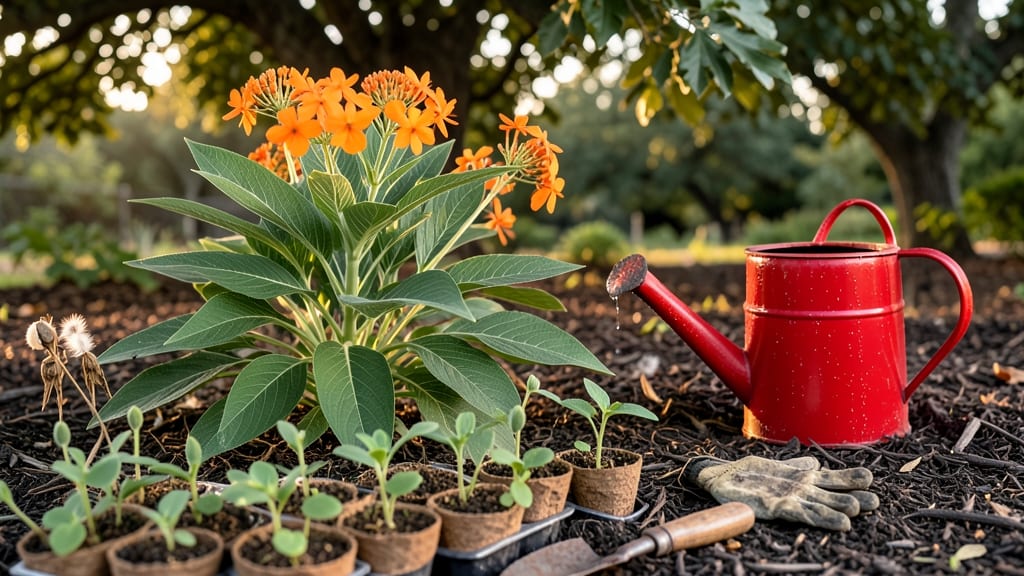
To plant milkweed successfully, choose USDA Zones 3–9 where it thrives in full sun and well-draining soil with moderate moisture. Native varieties like Asclepias tuberosa and Asclepias syriaca perform best in open garden beds or meadows, providing essential habitat for monarch butterflies.
Milkweed's hardiness spans from cold northern climates to warm southern regions, making it adaptable across the U.S. 🌱 The key is matching the species to your local conditions—Asclepias tuberosa handles drought better than Asclepias syriaca, which prefers slightly more consistent moisture.
I always recommend testing your soil's drainage first, as soggy roots lead to rot. Planting in clusters of 3–5 plants creates a more inviting stopover for migrating monarchs, while spacing them 12–18 inches apart reduces competition for nutrients.
For best results, aim for at least 6–8 hours of direct sunlight daily, though some varieties tolerate partial shade in hotter zones. The right placement not only boosts plant health but also maximizes its ecological impact—monarchs rely on these plants for survival during their annual migration.
If you're in a drought-prone area, consider mulching to retain moisture without smothering the roots.
💡 In This Article
- Optimal USDA Zones and Climate for Milkweed Growth
- Soil, Sunlight, and Spacing Tips for Thriving Milkweed
Optimal USDA zones and climate for milkweed growth
Milkweed's adaptability spans USDA Zones 3–9, but its performance varies dramatically by species and microclimate. The hardiest varieties, like Asclepias syriaca, endure -40°F winters in Zone 3, while Asclepias fascicularis thrives in Zone 9's 90°F+ summers.
What's fascinating is how milkweed's deep taproots (reaching 3–5 feet) allow it to access water during droughts—critical for survival in arid regions like the Southwest.
The real secret lies in timing: most milkweed species germinate best when soil temperatures hit 60–65°F, which typically occurs in late spring after the last frost. Early planting (March–April in cooler zones) gives roots time to establish before summer heat.
In contrast, Asclepias tuberosa (butterfly weed) actually prefers warm soil—planting too early can trigger rot. 🌱 This species also handles heat better than others, making it ideal for Zone 8–9 gardens where afternoon shade becomes essential during peak summer.
Frost sensitivity differs by stage: young seedlings can't tolerate temperatures below 32°F without protection, while mature plants often survive light frosts.
Here's where regional adaptations shine—northern varieties like Asclepias incarnata (swamp milkweed) develop thicker stems to resist wind and snow, while southern types like Asclepias humistrata have broader leaves to dissipate heat. The takeaway? Match your species to your last frost date and summer heat intensity.
What most gardeners overlook is how milkweed's flowering time correlates with monarch migration. Planting Asclepias tuberosa ensures blooms appear June–August, aligning perfectly with monarchs' southward journey. In contrast, Asclepias syriaca flowers later (July–September), supporting both migrating adults and emerging caterpillars.
This timing difference explains why some regions see more monarch activity—it's not just about having milkweed, but having it at the right moment.
For drought-prone areas (Zones 7–9), consider Asclepias subulata (pincushion milkweed), which thrives on less than 1 inch of water per week once established. Its succulent leaves store moisture like a built-in reservoir. Meanwhile, in wetter climates, Asclepias incarnata handles up to 2 inches of rain weekly without developing fungal issues.
The key is understanding your local precipitation patterns—milkweed's roots need oxygen, so waterlogged soil is its Achilles' heel.
One pro tip: in Zone 4–5 areas, plant milkweed near south-facing walls or fences to create a microclimate that's 5–10°F warmer than surrounding areas. This simple trick extends the growing season by 2–3 weeks, giving plants more time to establish before winter.
The same strategy works in Zone 9–10 to protect plants from late-season frosts.