
Size
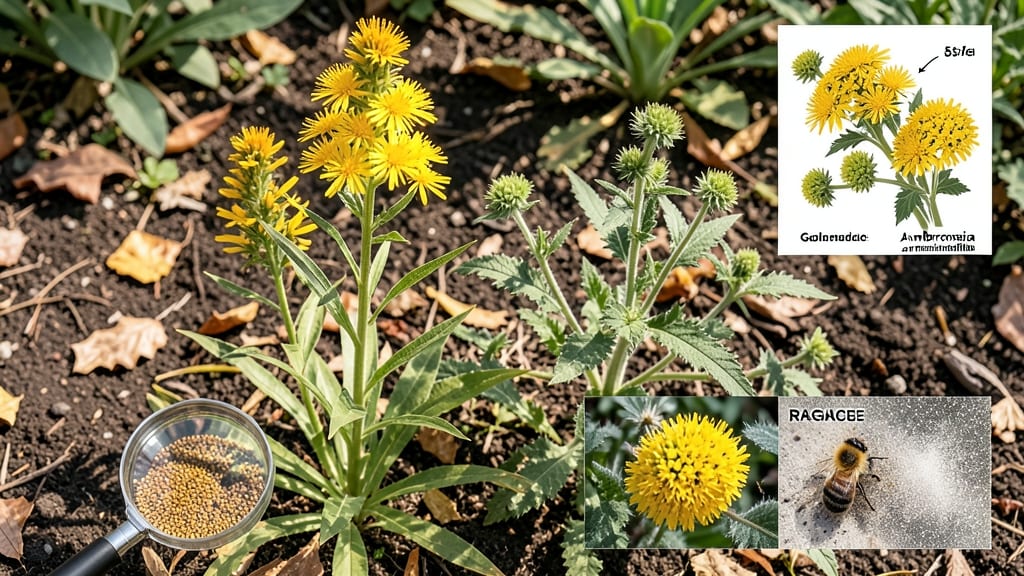
Goldenrod and ragweed are not the same plant, though they bloom simultaneously and are often wrongly blamed for summer allergies. Ragweed produces allergenic pollen, while goldenrod’s pollen is too heavy to trigger airborne reactions, making it harmless to allergy sufferers.
Goldenrod and ragweed often get confused because they both thrive in late summer and share similar yellow blooms, but their pollen behavior couldn't be more different. 🌼 Ragweed's lightweight pollen spreads easily in the wind, triggering those dreaded allergy symptoms, while goldenrod's dense, sticky pollen rarely becomes airborne.
This misconception has led many to unfairly blame goldenrod for seasonal allergies when it's actually ragweed causing the problems.
What's interesting is how their physical differences make them easy to tell apart once you know what to look for. Goldenrod has feathery, plume-like flowers that grow in upright clusters, while ragweed's flowers are small, greenish, and grow in less conspicuous clusters at the base of the plant.
The leaves also differ—goldenrod's are narrow and lance-shaped, while ragweed's are more triangular with jagged edges.
💡 In This Article
- Key Botanical Differences Between Goldenrod and Ragweed
- Managing Allergies: Goldenrod’s Role in Landscaping
Key botanical differences between goldenrod and ragweed
The most striking difference between these plants lies in their flower structures. Goldenrod (Solidago spp.) produces dense, upright clusters of tiny tubular flowers that resemble bright yellow plumes, while ragweed (Ambrosia spp.) has small, greenish flowers arranged in less conspicuous spikes at the base of its stems.
Ragweed's flowers are so inconspicuous that many people overlook them entirely, yet they're the primary source of allergenic pollen.
Pollen characteristics create the biggest allergy divide. Ragweed produces 1 billion pollen grains per plant annually, each weighing just 0.000000000002 grams—light enough to travel miles on wind currents.
Goldenrod's pollen, however, is 20-30 times heavier and shaped like tiny, sticky spheres that cling to pollinators like bees and butterflies instead of becoming airborne. This fundamental difference explains why goldenrod rarely triggers allergic reactions while ragweed causes misery for millions.
Leaf shapes provide another clear identification marker. Goldenrod leaves are narrow, lance-shaped, and arranged alternately along the stem, creating a feathery appearance when viewed from above. Ragweed leaves, in contrast, have a rough, triangular shape with jagged edges and grow in opposite pairs along the stem.
These differences become particularly noticeable when the plants are examined up close during their peak bloom season from August through October.
The growth habits also differ significantly. Goldenrod typically reaches 2-5 feet tall with multiple upright stems forming dense clumps, while ragweed grows more aggressively as a weedy annual that can spread rapidly through seed production.
Ragweed's stems are often hairy and branched near the base, while goldenrod's stems are smoother and more uniformly upright.
Ecologically, these differences matter too. Goldenrod's dense flower clusters attract bees, butterflies, and other pollinators that can't effectively use ragweed's flowers. The bright yellow blooms of goldenrod serve as a beacon for beneficial insects, making it a valuable plant for supporting biodiversity in gardens and natural areas.
What's fascinating is how these botanical differences translate into practical identification. When in doubt, look for three key features: flower arrangement (plumes vs. spikes), leaf shape (lance-shaped vs. triangular), and growth habit (upright clumps vs. sprawling branches).
These visual cues make it possible to distinguish between them with 90% accuracy through simple observation.