
Companion Plants
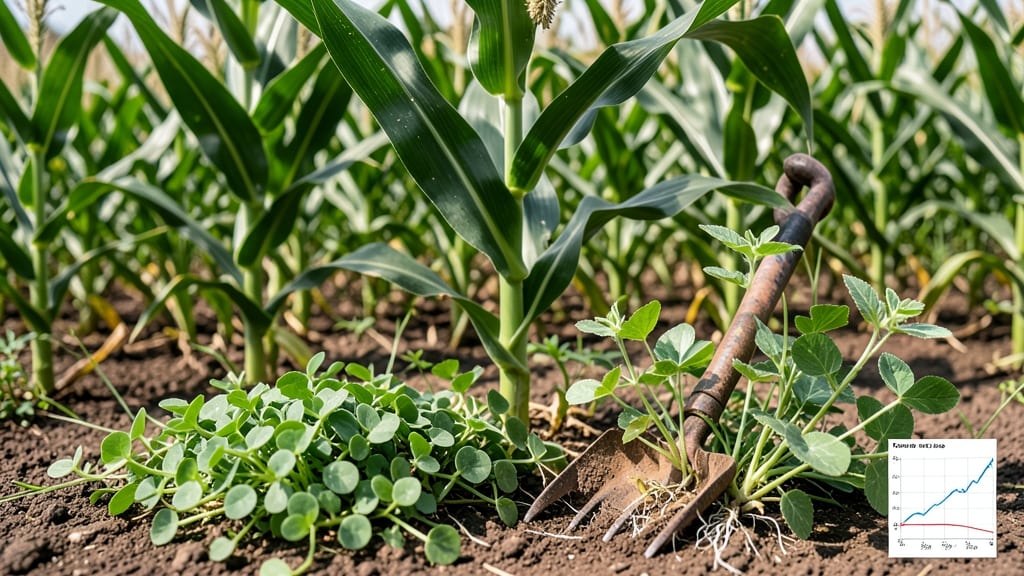
Weed in crop fields affects crop plants by aggressively competing for water, nutrients, and sunlight, which can slash yields by up to 50%. Its invasive root systems also degrade soil quality, accelerate erosion, and spread pathogens that compromise the health of key crops like corn, soybeans, and vegetables.
Weeds don't just take up space—they actively sabotage your crops through a mix of resource theft and chemical warfare. 🌱 Many weeds release allelopathic compounds that inhibit seed germination and stunt root growth, while others form dense canopies that block 40-60% of sunlight from reaching your plants.
The damage compounds over time: studies show that unchecked weed infestations can reduce soybean yields by 30-50% within just 6-8 weeks of emergence.
What's worse, their deep root systems compete with your crops for moisture down to 3 feet deep, leaving your plants parched even when the soil looks damp.
This isn't just about lost harvests—it's a cascading problem. Weeds like pigweed and lambsquarters create microclimates that trap moisture, creating ideal conditions for fungal diseases such as Fusarium wilt in tomatoes or Phytophthora root rot in potatoes.
The economic toll is staggering: the USDA estimates weed control costs farmers $10 billion annually, with small-scale growers often bearing the brunt through reduced marketable produce. The good news? Vigilant monitoring and early intervention can cut these losses by 70% or more.
💡 In This Article
- Mechanisms of Weed Competition in Crop Fields
- Preventing Weed Damage: Organic and Chemical Solutions
Mechanisms of weed competition in crop fields
Weeds deploy a multi-pronged attack on crops, starting with nutrient depletion. Their rapid growth rates—some weeds like morning glory can grow 6 inches per day—allow them to absorb nitrogen, phosphorus, and potassium at alarming rates.
A single pigweed plant, for example, can extract 30% more nitrogen from the soil than a corn plant of the same age, leaving your crops nutrient-starved. This competition becomes especially critical during the vegetative growth stage (first 6-8 weeks) when crops need these nutrients most for leaf and root development.
The real game-changer is allelopathy—a chemical warfare tactic where weeds release toxic compounds that inhibit seed germination and root growth. Black walnut trees, for instance, produce juglone, a toxin that can kill sensitive crops like tomatoes within a 2-foot radius.
Even less dramatic weeds like chickweed release benzoic acid, which slows down photosynthesis in nearby plants by up to 25%. This chemical interference explains why some fields show stunted growth even when weeds appear sparse—it's not just about space, but about invisible biochemical sabotage.
Sunlight competition creates another critical bottleneck. Dense weed canopies can block 40-60% of sunlight from reaching crop plants, forcing them into a "shade avoidance syndrome" where they grow tall and spindly while diverting energy away from fruit or seed production.
In soybeans, this shading effect alone can reduce yields by 15-25% because the plants can't photosynthesize efficiently.
The visual difference is striking: compare a weed-free field where soybeans stand 2-3 feet tall with strong stems to one infested with lambsquarters where plants may only reach 1 foot with pale, thin leaves.
Root competition takes the battle underground where it's often invisible. Weeds like nutsedge develop extensive rhizome networks that spread horizontally and vertically, competing with crop roots for moisture down to 3 feet deep.
This underground battle becomes particularly vicious during drought conditions when both weeds and crops are fighting for the same limited water supply. The result? Your crops wilt even when the soil appears moist at the surface—a classic sign of deep-rooted weed competition.
Perhaps most insidiously, weeds create disease hotspots by altering microclimates. Their dense foliage traps moisture, creating ideal conditions for fungal pathogens like Fusarium or Phytophthora. In potato fields, for example, weeds can increase the incidence of late blight by 300% by maintaining high humidity levels near the plant canopy.
The physical damage from these diseases further weakens crops, making them more susceptible to insect attacks and secondary infections.
Understanding these mechanisms helps explain why yield losses can reach 50% or more in severe cases. The damage isn't just additive—it's multiplicative. A field with both nutrient competition AND shading AND disease pressure will see losses far greater than the sum of individual factors.
For example, a study in Nebraska found that corn yields dropped by 72% when weeds were present compared to weed-free plots, with the most severe losses occurring when multiple competition factors overlapped.