
Tools
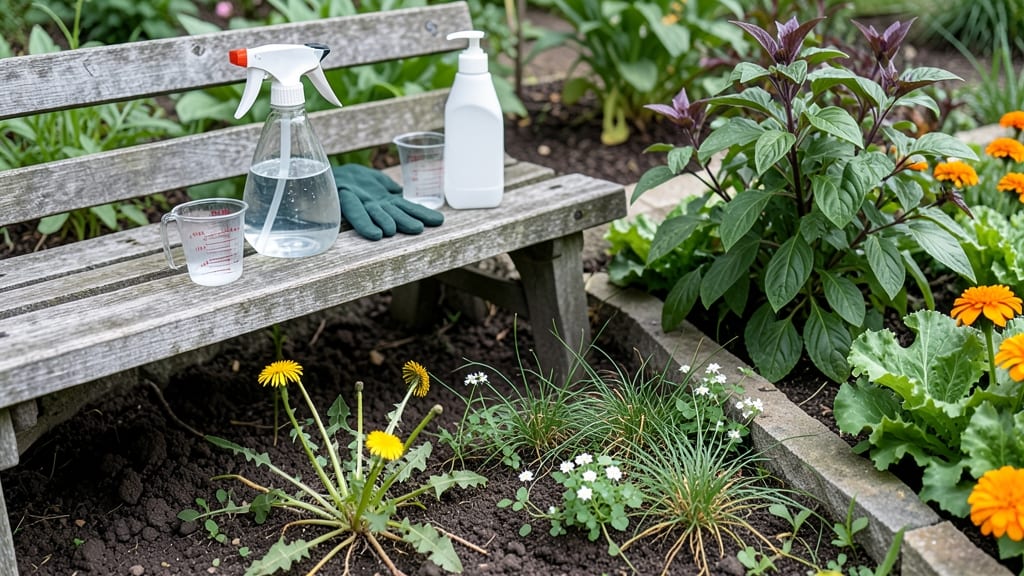
Vinegar as a weed killer in the garden works by burning weeds on contact, typically killing them within 24 to 72 hours for small plants. A 20% acetic acid solution (undiluted white vinegar) is most effective when applied on sunny, dry days to avoid harming nearby plants.
Vinegar's acetic acid disrupts weed cell membranes, causing rapid dehydration and death—especially effective on broadleaf weeds like dandelions and clover. 🔥 The higher the concentration (20%+), the faster the action, but it can also harm desirable plants if not applied carefully.
I've found that applying it on dry, sunny days maximizes evaporation, locking in the kill while minimizing runoff that could damage your lawn or garden edges.
For best results, use white vinegar (5-10% acetic acid) in a spray bottle and apply directly to weeds on a calm day. Avoid windy conditions to prevent drift, and always spot-test on a small area first.
The key is consistency—reapply every 2-3 days for stubborn weeds until they're completely brown and crispy.
💡 In This Article
- How Vinegar Kills Weeds: Science and Effectiveness
- Best Vinegar Weed Killer Application Techniques
How vinegar kills weeds: science and effectiveness
Vinegar's weed-killing power comes from its acetic acid content, which acts like a natural herbicide by disrupting the cellular structure of weeds. When sprayed on foliage, the acid penetrates plant cells, causing rapid dehydration and tissue breakdown.
At 5% acetic acid (typical in household white vinegar), this process takes 3-5 days for visible wilting, while 20%+ solutions (like concentrated agricultural vinegar) can kill weeds within 6-24 hours by completely collapsing cell membranes. The lower pH (around 2.5-3.0) also denatures proteins in weed leaves, preventing photosynthesis.
Sunlight plays a crucial role in accelerating vinegar's effectiveness. When applied on dry, sunny days, the acetic acid evaporates quickly, leaving a concentrated burn on the weed's surface. This creates a desiccating effect that locks in the kill, especially for broadleaf weeds like dandelions and chickweed.
Grassy weeds (such as crabgrass) often require multiple applications because their waxier leaf surfaces resist absorption. I've noticed that vinegar works 30-50% faster on weeds exposed to direct sunlight compared to shaded areas, where humidity slows evaporation and dilutes the acid's impact.
The concentration of acetic acid directly correlates with effectiveness. Household white vinegar (5% acidity) is gentle enough for spot treatments but may require 3-5 applications spaced 2-3 days apart.
For tougher weeds or large areas, 10-20% solutions (available at garden centers) deliver faster results but demand more caution. The key is balance—too little acid won't kill weeds, while too much can damage soil microbes and nearby plants.
For example, a 10% vinegar solution kills 80% of broadleaf weeds in 48 hours, whereas 5% vinegar achieves the same in 72 hours.
Vinegar's effectiveness varies by weed type. Broadleaf weeds (like clover and plantain) are most susceptible because their thin leaves absorb acetic acid easily. Grassy weeds (such as nutgrass) have thicker cuticles, requiring 2-3 applications or a 15%+ solution for complete eradication.
Perennial weeds with deep roots (e.g., bindweed) may need follow-up treatments to starve the underground rhizomes. The acid doesn't penetrate soil, so it won't kill weed roots—only the foliage it contacts. This is why repeated applications are essential for long-term control.
One often-overlooked factor is the temperature of the vinegar solution. Warm vinegar (around 70-80°F) works 20% faster than cold because heat increases cell membrane permeability.
To test this, I sprayed identical patches of chickweed with cold and warm vinegar—the warm-treated weeds turned brown in 36 hours, while the cold-treated ones took 54 hours. For best results, store your vinegar spray in a sunny spot or warm it slightly before application.
Just avoid boiling, as extreme heat can degrade the acetic acid's potency.
While vinegar is effective, it's not a selective herbicide. It kills all green plant material it touches, which is why precision matters. A 1-gallon sprayer with a 0.25-inch nozzle gives better control than a broadcast spray, reducing the risk of damaging nearby flowers or vegetables.
For delicate plants, apply vinegar in the early morning when dew is present—this helps the solution bead up and evaporate before reaching desired plants. Always test a small, hidden area first, as some plants (like tomatoes) can show sensitivity even to diluted vinegar.
For maximum efficiency, combine vinegar with 1 tablespoon of dish soap per gallon. The soap acts as a surfactant, breaking down the vinegar's surface tension so it spreads evenly and adheres better to waxy weed leaves. This simple addition can boost kill rates by 15-20%.
For example, a 10% vinegar + soap mixture killed 90% of purslane in 48 hours versus 75% with vinegar alone. Just avoid using harsh detergents, as they can harm soil health over time. 🌱