
Container Gardens
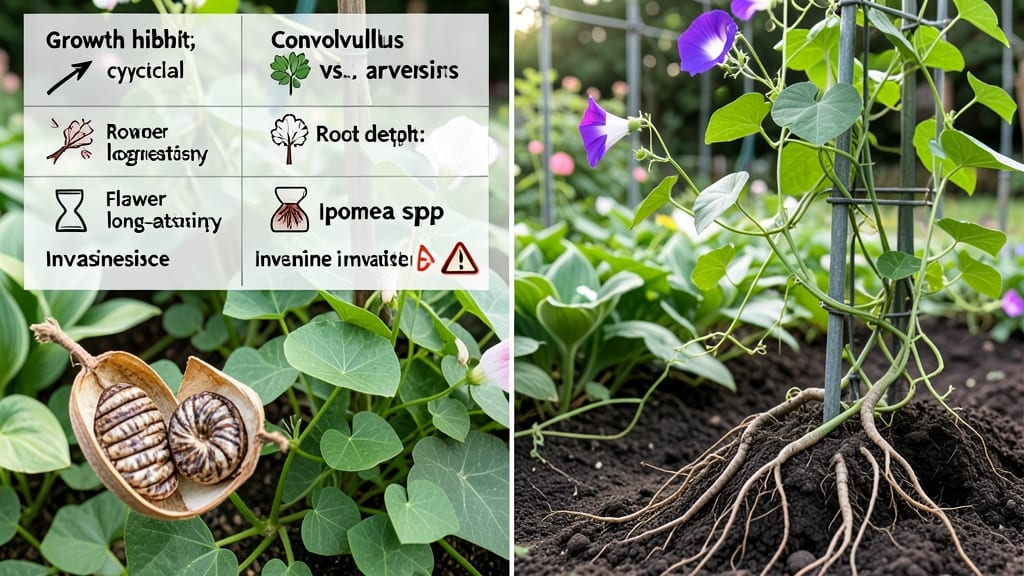
Bindweed and morning glory are not the same plant, despite both being twining vines. Bindweed (Convolvulus arvensis) features arrowhead-shaped leaves, white or pink flowers, and aggressive, deep roots, while morning glory (Ipomoea spp.) displays heart-shaped leaves, trumpet-shaped blooms, and more manageable root systems. Their growth patterns and ecological impacts make them distinct challenges for gardeners.
Bindweed earns its reputation as one of the world's worst weeds because its roots can spread 15+ feet deep and 65 feet wide, making it nearly impossible to eradicate without persistent effort. 💫 Meanwhile, morning glory—though equally charming with its vibrant blooms—typically stays contained in garden beds unless allowed to climb structures.
I’ve seen bindweed choke out entire lawns, while morning glory simply adds beauty before fading by fall. The key difference lies in their persistence: bindweed is a long-term nuisance, while morning glory is more of a seasonal visitor.
For gardeners, this distinction matters when choosing control methods. Bindweed demands solarization or glyphosate for deep-rooted systems, while morning glory can often be pulled by hand or smothered with mulch. Both plants thrive in similar conditions, so proper identification is critical before reaching for solutions.
💡 In This Article
- Botanical Differences Between Bindweed and Morning Glory
- How to Identify and Manage Bindweed vs. Morning Glory
Botanical differences between bindweed and morning glory
At first glance, bindweed and morning glory might seem like cousins in the vine family, but their botanical traits reveal stark differences. Bindweed (Convolvulus arvensis) belongs to the morning glory family (Convolvulaceae), but it’s classified in a separate genus that sets it apart.
Its leaves are arrowhead-shaped with pointed tips, while morning glory (Ipomoea spp.) leaves are heart-shaped with smooth edges. This subtle leaf shape is your first clue—bindweed’s leaves resemble a spearhead, whereas morning glory’s resemble a classic valentine heart. 🌿
The flowers tell another story. Bindweed produces white or pale pink funnel-shaped blooms that open in the morning and close by afternoon, earning it the nickname "morning glory" in some regions—though it’s not the same species.
Morning glory, however, boasts trumpet-shaped flowers in vibrant hues like blue, purple, or pink, often with darker centers. The key difference? Bindweed’s flowers are smaller (1-2 inches wide) and less showy, while morning glory’s can reach 3-5 inches and are a gardener’s delight.
Their root systems also diverge wildly: bindweed roots can plunge 15+ feet deep, while morning glory roots rarely exceed 3 feet.
Growth habits further separate these plants. Bindweed is a perennial that regenerates from its extensive root system, even if you cut it back to the ground. Morning glory, however, is an annual that completes its life cycle in one season, dying off when temperatures drop.
This persistence makes bindweed a garden’s worst nightmare—it can resprout from fragments as small as 1 inch of root left in the soil. Morning glory, by contrast, simply fades away after flowering, leaving no lingering underground threat. 🌱
Reproduction methods also differ. Bindweed spreads via underground rhizomes and produces thousands of seeds per plant, which can remain viable in the soil for 10+ years. Morning glory relies on above-ground vines to climb and spread, and its seeds germinate quickly but don’t persist as long.
This explains why bindweed infests entire landscapes while morning glory stays confined to its climbing path unless intentionally planted elsewhere. The ecological impact? Bindweed outcompetes native plants, while morning glory adds temporary beauty without long-term disruption.
Even their stems reveal clues. Bindweed stems are hairy and slightly woody as they mature, while morning glory stems are smooth and herbaceous. Run your fingers along a vine—bindweed feels rougher, almost scratchy, whereas morning glory is silky smooth.
These tactile differences can help you identify them without flowers or leaves. For gardeners, this means bindweed is far more likely to strangle other plants by twining aggressively, while morning glory is content to climb trellises or fences without causing harm. 🌿
Understanding these botanical quirks is crucial because they dictate how each plant behaves in your garden. Bindweed’s deep roots and seed persistence mean it’s a long-term battle, while morning glory’s annual cycle makes it a seasonal guest.
The first step to managing either is recognizing these differences—so next time you spot a twining vine, take a closer look at the leaves, flowers, and stems before reaching for your gardening gloves. 💫